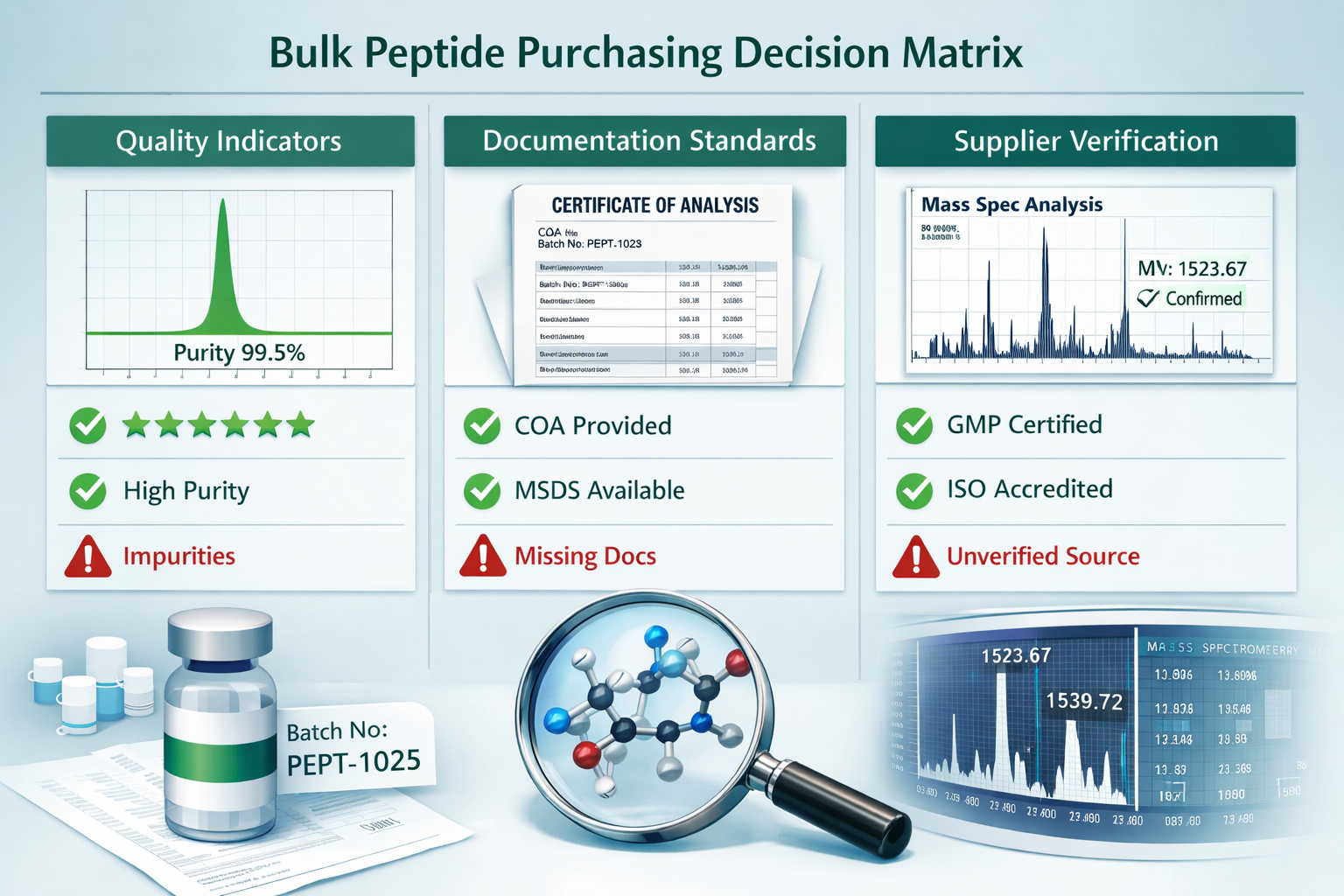
Peptide And Peptoid Synthesis Core Any considerable discrepancy recommends the example isn't the claimed peptide. If you think 100% web content when the actual web content is 75%, your computed dosages are 25% less than meant. This clarifies why some scientists report weak effects than anticipated despite complying with released protocols. ESI-MS (Electrospray Ionization Mass Spectrometry) produces multiply-charged ions, which enables evaluation of larger peptides and supplies higher level of sensitivity. ESI is typically combined with fluid chromatography (LC-MS), integrating splitting up and identification in a solitary analysis. The repercussions mediocre peptides prolong beyond lost money. Some vendors sell items containing different substances than advertised. Others weaken peptides substantially while asserting complete potency. A couple of sell totally inert substances, capitalizing on the trouble of detection without correct testing. The peptide in your vial may not also be the compound you purchased. The lab offers HPLC pureness analysis and mass spectrometry identity verification. A Amino Acid Chains chromatogram shows heights standing for different substances discovered during HPLC analysis. The primary top, usually the biggest, represents your target peptide. Item summaries and categorizations do not imply any kind of healing results. Kai is the laboratory's AI research assistant-- powered by Claude (Anthropic) and GPT (OpenAI)-- responsible for technological writing, literature review, COA verification, and substance analysis. Together they create the research study web content published on this website. Detoxified by preparative RP-HPLC with quality assurance Go here analysis. This quality fits the majority of in vitro research applications-- receptor binding assays, enzyme task studies, and cell culture experiments. Not every application demands 99% purity, and purification is a substantial element of peptide production expense. The pureness of peptides is figured out utilizing logical techniques such as reversed-phase high efficiency fluid chromatography (RP-HPLC) and mass spectrometry (MS). Amino acid analysis can additionally be made use of to determine return or actual amount of peptide. Peptide purity screening is among one of the most crucial elements of research study peptide quality control. GLP-1 agonists and associated substances for weight management applications carry particular worries. These peptides resolve particular receptor mechanisms, making identification confirmation particularly essential. A substance with similar yet various activity can produce unforeseen results. Finnrick offers free peptide testing for examples delivered to their facility.
- If you think 100% content when the real content is 75%, your calculated doses are 25% lower than planned.HPLC can sustain claims about chromatographic pureness, pollutant top burden, and deterioration patterns when the method is suitable and the chromatogram is offered.A solid peptide screening operations utilizes methods that respond to complementary concerns.The most rigorous grade, involving careful HPLC purification-- often several rounds-- and strenuous QC.
What Is The Difference In Between Hplc Purity And Mass Spectrometry Confirmation?
Poor-quality peptides (those with undiscovered contaminations, incorrect series, or deteriorated elements) can cause deceptive information and irreproducible results. In fact, proteins and peptides are among the most extensively made use of laboratory reagents, yet research studies have shown that their high quality is frequently poor, causing bad information reproducibility. Beginning with appropriate research laboratory validation is therefore a crucial part of a scientist's quality control workflow. By demanding peptides that include verification of pureness and identification, scientists can considerably minimize the danger of speculative artefacts. This adds to the wider reproducibility crisis in scientific research. On the other hand, using peptides that have passed third-party laboratory recognition helps make sure that the observed experimental results are really as a result of the designated peptide and not because of impurities or mistakes.What Is Peptide Testing?
Notably, this purity number is generally established after purification (e.g. by HPLC) and concentrates on peptide impurities-- it does not count residual water, salts, or counter-ions in the dried peptide powder. To put it simply, the purity portion is about the composition of peptide varieties in the sample, not the weight contribution of water or salts. If you've ever gotten an artificial peptide for a lab experiment, you have actually most likely observed a purity portion on the certificate of analysis-- normally worths like 95%, 98%, or perhaps 99%. Peptide purity is an important quality metric that informs you what fraction of a peptide example is the designated item versus undesirable spin-offs. In basic terms, a peptide provided as 95% pure consists mostly of the target peptide (95%), with the staying ~ 5% composed of contaminations. These pollutants can include things like reduced or truncated sequences, deletion variations, oxidized residues, or various other minor side-products from the synthesis process.What equipment is made use of to test peptide purity?
Peptide pureness is consistently identified by HPLC (high efficiency fluid chromatography). This approach enables separation and loved one metrology of each peptide synthesized. If combined to a mass spectrometer (MS), this offers molecular mass/ identity info of the target peptide and accompanying impurities.